Independen --- Yulaika Romandhani felt that she is more anxious for her second pregnancy than her previous one.
Romandhani was pregnant at a time when Indonesia is being struck by the Covid-19 pandemic. Causing doctors to advise against the mother of one to limit her time outside her home, including hospital visits.
“I am more worried about this pandemic. Especially when visiting the hospital and interacting with them [hospital administration, pharmacy, doctors, etc.] who have to deal with [potential] Covid-19 patients every day,” Romandhani told Independen.id.
Romandhani’s scheduled visits to the doctor had also been reduced due to this concern.
“Usually, on the last trimester, I would have a bi-weekly check. But now it’s only once every month. From the beginning of [my] second pregnancy, I’ve only been having a monthly check-up,” said Romandhani, who had found out about her pregnancy in December last year.
Marina Nasution was expecting her first child. The Jatinegara-East Jakarta resident also expressed her concerns about the reduced pregnancy medical checks during the Covid-19 pandemic.
The decrease was not only to reduce the intensity for pregnant women to leave their home but also reduced doctor consultation time amidst the increasing number of pregnancies.
This condition worried Nasution, especially as a first-time mother-to-be. Besides, both she and her husband lived far away from their parents.
Even though the hospital that Nasution go to provided online consultation services to help expecting mothers to get more information, she still felt uncomfortable.
“My [first] doctor was not very communicative. I was also too clueless to ask questions. Probably because this is my first time, so I was clueless,” Nasution told Independen.id.
Unwilling to put up with the lack of information, Nasution decided to switch her ob-gyn in the middle of her pregnancy. She felt that her current doctor is more communicative towards the patients.
“Honestly, the information from my first doctor was not so comprehensive. I was greatly helped by social media. Nowadays, there are many parenting [and] pregnancy education accounts in social media such as Instagram and YouTube. I also downloaded pregnancy education apps like Teman Bumil [Pregnancy Friend] so that I could monitor my pregnancy,” said Nasution.
During her pregnancy, Nasution preferred to go to a hospital 20-minutes away from her house. In addition to being closer to home, the bills were also covered by her husband’s work insurance. But still, it could not contain Nasution’s anxiety.
Similarly, Romandhani also experienced difficulties in getting information about pregnancy during the pandemic.
What she could do, however, is finding out for herself by reading books, sharing experiences with other expecting mothers online through WhatsApp groups, Instagram, and Zoom webinars, as well as articles on the internet.
Rising Labor Costs
Not only prenatal information and visits that have drastically changed, but the cost of childbirth has also swelled, and this added to the worries for expecting parents.
Romandhani, who lived in Bantul, Yogyakarta, opted to have her prenatal checks at the hospital instead of the community health center (Puskesmas) for fear of Coronavirus transmission.
It had not been an easy decision because it means that she had to spend more money on her second pregnancy.
Even though she was eligible for the state-owned healthcare BPJS Kesehatan as well as insurance coverage from the office where she works. Her BPJS Kesehatan could only cover the cost of birth at the level 1 health facility, the Puskesmas. While the hospital where she has her prenatal checks does not accept normal labors with BPJS.
“My residential is the reddest zone [area with very high Covid-19 cases] in the district. I chose the hospital, not Puskesmas, because of Coronavirus concerns. The Banguntapan 1 and 2 Puskesmas had been temporarily closed the other time because a doctor and several nurses tested positive for Covid-19,” said Romandhani.
Meanwhile, Romandhani’s health insurance from her office does not cover birthing costs.
Just like Romandhani, Nasution also worried about the high birthing cost in the time of a pandemic. Based on the information she gathered from social media, the spike in birth costs was caused by additional health protocols that were in place due to the Covid-19 pandemic.
Romandhani and Nasution’s anxiety were all reasonable. Restu Diantina Putri gave birth to her first child in May. And she could confirm that the increase in childbirth cost was due to the additional protocols. And the extra cost was of no small amount.
“Before labor, there were more protocols such as the rapid test and thorax Rontgen for the mother and her husband or birthing partner. It just so happens that they found out that my husband had mild pneumonia, so they assigned us to the VIP room. Other patients were not allowed. No visitors either,” Putri told Independen.id.
During her pregnancy, Putri also admitted that she looked for pregnancy education—including the cost of childbirth online, not from the hospital.
After giving birth, she also only did one postnatal check at the hospital.
“Only one check after delivery. I should have done one more, but since my condition has stabilized, I did not go. Apart from [fear of] Covid, it’s also the [extra] costs,” she said.
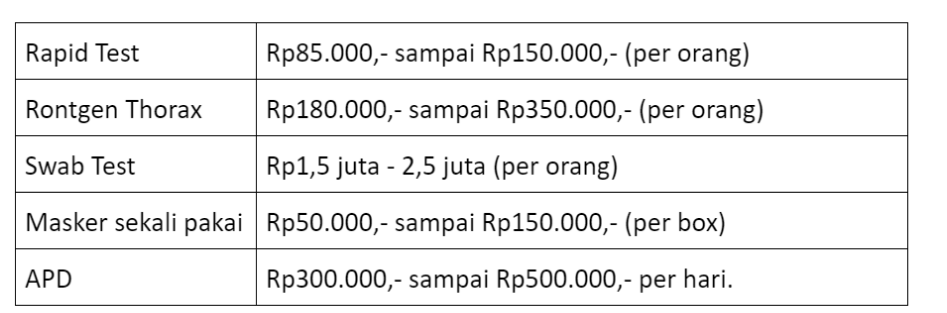
* Rapid test, thorax Rontgen, and swab test fees per person. During labor, not only the mother who was tested but also her birth partner
It was neither the dream of Romandhani nor Nasution to carry a child in the time of a pandemic. Especially considering the number of Covid-19 cases that continue to increase every day.
Based on the data on the Health Ministry website per September 11, 05.16 am WIB (Western Indonesian Time), there were 207,203 confirmed Covid-19 cases in Indonesia and 8,456 total deaths.
Pregnancy on the Rise during PSBB
The Covid-19 pandemic, however, is followed by an increase in the number of pregnancies, especially after the Large-Scale Social Restriction (PSBB) policy was imposed by the government.
Head of the Population and Family Planning Agency (BKKBN), Hasto Wardoyo, said that there had been a decline of the Family Planning (KB) program participants in April.
“Active KB [participants] per month was 36 million. There had been a sheer drop in April. On average, there was a 10-15 percent decline of acceptors per province compared to the previous month,” said Wardoyo as quoted by Kontan in June.
He also estimated that between those periods, there is an increase in pregnancy rate by around 370,000 to 500,000. He claimed that he got the figures from the lowest pregnancy percentage of Fertile Age Couples (PUS): 15 to 20 percent.
During the Covid-19 pandemic, several regions have declared an increase in pregnancy.
In West Java, for example, Governor Ridwan Kamil announced the high surge of pregnancy during the provincial PSBB. According to Pikiran Rakyat, the cities with the highest number of pregnancies were Bandung (2,210 people), Cirebon (2,210 people), Garut (1,950 people), Tasikmalaya (1,205 people), Ciamis (1,188 people), and Sumedang (1,175 people).
The high pregnancy rate also occurred in several regions in Central Java. According to Okezone.com, the Population Control and Family Planning Office (DPPKB) in Blora district recorded 4,980 pregnancies in June. The rate had started to increase in March and continued to climb up until June.
Similarly, in Batang, the pregnancy rate had been going upward by 10 to 15 percent. According to Radar Pekalongan, in January, there were only 735 pregnancies recorded, but in June, it had grown to 913 new pregnancies. In Magelang, Radar Banyumas reported a significant increase from May in three subdistricts, namely Dukun (132 percent), Ngluwar (47 percent), and Mertoyudan (34 percent).
Pregnant Women Facing Problematic Healthcare and Lack of Mental Support
Women’s Health Foundation (YKP) Director Nanda Dwinta Sari explained that women’s reproductive health rights are not only about access to health facilities (Faskes).
“Reproductive health is not limited to medical issues, but also mental health, hormonal changes. That is all visible,” Sari said, firmly.
Indonesian Women’s Coalition (KPI) Secretary-General Mike Verawati recounted the experience of one of her friends who had to give birth during the pandemic.
“A friend of mine just recently gave birth. It was her first pregnancy [and] needed the [mental] support. But her family could not be there for her. Meanwhile, she had to undergo a c-section in the middle of the night. Her parents were worried, and so did she. Eventually, she had her [procedure], to give birth, with high blood pressure. Because she was stressed out. When in fact, she’s actually healthy. This is also a problem, right?” said Verawati.
The issue of women’s reproductive health rights gets increasingly complicated for people living in remote areas and poor communities. Sari and Verawati believed that the government should have paid more attention to women’s rights during the Covid-19 pandemic. They have to keep in mind that pregnant women and new mothers belong to a vulnerable group.
“[It seems that] reproductive health is not a concern. So, we urge the government to immediately amend their policy to be more flexible because of the current condition,” said Sari.
“This is homework for all of us [and] we have to advocate for it. We must push the government to respond immediately to situations like this. Unfortunately, when we try to start a dialogue with the Ministry of Health, it’s not that easy,” she continued.
“In the city, the number of midwives may already be sufficient. But the problem in remote areas is that [they] are limited. Our outreach proposal faces a problem with midwives' availability. Because not all villages, towns, and districts have enough midwives,” said Verawati.
Reports that went into YKP and KPI said that many mothers complained about the lack of information—whether they live in a major city or a small town. And when confronted with a situation like this, they instead listened to unofficial information.
Read more: Potential Population Explosion Due To Covid-19
Reporter: Widia Pramestika/D02
This reporting is part of a COVID-19 response transparency and accountability program supported by the Alliance of Independent Journalists (AJI) Indonesia and UNESCO.
*This article was published in Bahasa at Independen.id in September 2020