Independen -- The 2019 Coronavirus Disease 2019 (Covid-19) in Southeast Sulawesi has had a broad impact, including on the economic sector. In this sector, it is workers who are significantly affected.
Small and medium enterprise workers are one of the most affected because there are no customers or unsold goods. Also, there are hotel workers who are dismissed because the hotel business is stagnating.
As in Lenni (37) and her family, the mother of two was quite well off before the Covid-19 pandemic. She had a business sewing wedding clothes while her husband worked at a financing company in Kendari.
Lenni ran a home business in their residence in the Anawai subdistrict. In a month, she could earn Rp3 million (US$271.39) while her husband (42) had a take-home pay of Rp1.8 million. The joint income from both husband and wife had been sufficient for the family.
However, when the Covid-19 pandemic began to spread to Indonesia in early 2020 and finally reached Kendari, Lenni gradually started to lose her customers. Likewise, the financing company where her husband had worked sent him home with no pay even after two years of employment. This condition had made it harder for them to make ends meet, including for their two daughters who are in junior high school.
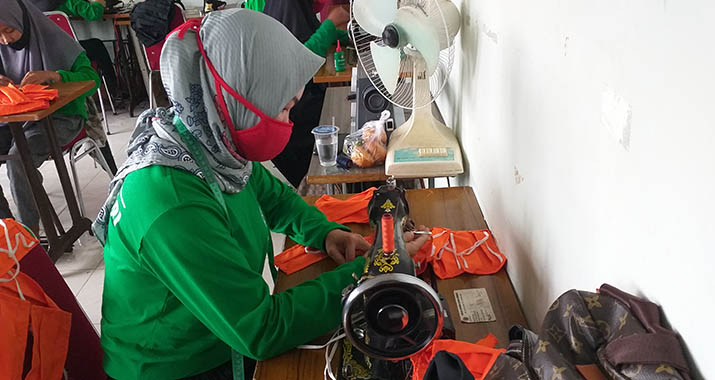
PANDEMIC IMPACT – As a Small and Medium Business worker, Lenni underwent training to improve her sewing skills at the Kendari Vocational Training Center (BLK), July 10, 2020. The mother of two was learning to make face masks. (Muhamad Taslim Dalma/ZONASULTRA.COM)
Lenni tried to find work at a more prominent tailor but was not accepted since the Covid-19 outbreak had reduced the number of orders drastically. Meanwhile, her husband tried to make money by becoming a motorcycle taxi driver (ojek). The income was less certain, approximately Rp50,000 per day. But that was how the family had been surviving on.
“[Rp50,000 per day] is not enough. But we try to make do,” Lenni said in the middle of her sewing training activity at the Kendari Vocational Training Center (BLK), July 10, 2020.
Lenni’s family also received Direct Cash Assistance (BLT) from the government of Rp600,000 per month. From May to July, Lenni had received three BLTs that she had been using to buy a 50kg sack of rice worth more than Rp500,000.
Lenni said she was sometimes stressed out thinking of her family’s economic situation. Especially when her husband returned home complaining that he didn’t get any customer.
Small-business owner Siti Rahmatia Ismail (52) from the Purirano subdistrict also had a similar pandemic complaint. She ran an assortment of business from craft accessory, dressmaking to selling various cakes/snacks. As a single parent, she had to get by living with her son, who was a high school student.

Small business owner Sitti Rahmatia Ismail showed the handmade accessories that she was unable to sell due to the Covid-19 pandemic.
From her various businesses, Ismail could get monthly sales worth Rp3 million. Profit from her sales was then used to pay for her and her son’s daily needs.
“Since [March], until now, there has been no sales. Cakes, stop. Nothing. I used to sell a lot of egg-coated nuts to small stalls but now none. Unfortunately, there are no buyers,” said Ismail, who was also attending the training at Kendari BLK with Lenni.
To survive the pandemic, Ismail had been sewing cloth face masks using her one and only sewing machine. She also sold them at half the market price. For example, a standard face mask was usually being sold at Rp15,000 per piece. She sold them for Rp8,000.
Apart from that, Ismail admitted that the government BLT that she had received twice—at Rp600,000 each in May and June, had been quite helpful. However, her economic condition had been middling at best. She still had to drain her bank account empty to pay the bills while running her mask business.
“It is dangerous for people who do not have strong faith if [this situation] continues. Alhamdulillah [Thank God], I’m not stressed. We [try to be] grateful. I believe in Allah’s provision, that’s all,” she continued.
With her status as a single parent, Ismail admitted that she had her own set of problems compared to other married women. For her, working nonstop was the key, even though the masks that she sews did not sell well.
Another worker that was sent home without pay was Siti Harlianti. When the pandemic hit, she had only been working for five months at D’Blitz Kendari Hotel. The 20-year old woman had temporarily stopped working since the Coronavirus broke out in March.

Siti Harlianti
As a single female, Harlianti relied on her mother, a widow. While at home, Harlianti helped her mother selling cakes. Before, her job at the hotel had earned her a Rp1.5 million monthly salary—enough for her and her mother.
During this pandemic, her family was also immensely helped by the government’s assistance. Her mother was eligible for the Family Hope Program (PKH), and Harlianti had also received Rp300,000 cash assistance. However, she was not quite sure from which program that was as she only received it once, transferred through a Regional Development Bank (BPD) account after filling up a government-issued form for Covid-19-affected workers.
“I was called to come back to work again, but I’m still scared. We work in the hotel, and you never know when disaster strikes [contracting the Coronavirus]. Everything’s not stable yet. Not many of us are coming to work either, unlike before,” said Harlianti in a phone call, July 8.
Impact on Business Sector
One of the businesses that had been hit hard by the pandemic was hospitality. The decline in occupancy rates caused many hotel employees to be sent home, as what happened to Harlianti.
Hotel D’Blitz Kendari Sales Marketing Mitha said that during the pandemic, her hotel had to send home around 30 employees. Some of them were contract workers, and some were daily employees for various functions.
“During the pandemic, 80 percent of employees were sent home. The salaries were also stopped,” Mitha said via a WhatsApp message on July 11.
The decline in occupancy rate at D’Blitz Hotel started when the first Covid-19 case hit the city in March and dipped at its lowest point in May. This resulted in a lack of income and employees being sent home.
In July, the hotel occupancy rate started to rise again after an edict issued by the National Police Chief was revoked to kick off the transition to the government's so-called “new life” or “new normal.” D’Blitz Hotel had also received the green light from the Kendari Health Office to operate as long as they implement the Covid-19 health protocol standard.
“As of July, almost 50 percent of the employees have returned to work,” Mitha continued.
According to the Indonesian Hotel and Restaurant Association (PHRI), there were 130 hotels in Kendari, 30 of which were star-rated hotels such as Claro, Same, Plaza In, Swiss Bell, and others—that were affected by the pandemic. And approximately 150 restaurants, eateries, and the like.
PHRI Southeast Sulawesi Secretary-General Eko Dwi Sasono said that in mid-July, the hotel business had started to grow again but not entirely. Hotels that were still closed were the non-star ones, while those that were star-rated have begun operating.
Sasono’s Cendana Hotel, a non-star lodging, had to close its doors in the last five months ago. The business closure led to zero revenue; employees had to be laid off with total salary cuts.

Cendana Hotel on Jalan Bunga Tanjung Kendari, one of the non-rated hotels affected by the Covid-19 pandemic. Until Monday (10/8/2020), the doors to the hotel were still chain-locked from inside.
Sasono admitted that his hotel had started to decline right before the pandemic. His business suffered even more so when the epidemic hits that he is currently in the process of filing for bankruptcy.
During the “new normal” or “new life” discourse, star-rated hotels were in the process of recovery. However, Sasono doubted the recovery process could be achieved within six months, mostly since the number of Coronavirus infection has continued to rise.
According to Sasono, many of the hotel’s potential businesses, or 85 percent, rely on the government. He referred to the many government events that used to be held at hotels. However, due to government budget cuts and refocusing, not to mention the ban on public gathering, had added to the woes of business owners.
PHRI noted a significant decrease in the occupancy rate. In star-rated hotels, room occupancy only reached 40 to 50 percent the highest. In comparison, non-star hotels’ occupancy rate only got to 30 percent—those with 0 percent occupancy were usually because the hotel was already closed in the first place.
The low occupancy rate had an immediate effect on employee payroll. Some hotels had to send their employees home without pay, while some reduced the cost by cutting employee hours.
According to the Southeast Sulawesi Manpower and Transmigration Office records, from April to July 10, 4,734 workers were dismissed in the province. The majority, or 4,518, were being sent home, and 216 were laid off.
Most of them worked in the tourism sector—for example, hotels, eateries, restaurants, including entertainment venues, while some in the mining sector.
Several scenarios were carried out by companies in downsizing their workers. Some send employees home without pay, 50 percent pay, 75 percent, and a few were being sent home while still receiving 100 percent of their wages.
“Those who are being sent home are very dependent on the financial condition of the company concerned. Being sent home means that they are given a break temporarily. The status of their employment has not ended,” said Head of Industrial Relations and Social Security Department at the Southeast Sulawesi Manpower and Transmigration Office Muhammad Amir Taslim, July 16.

Muhammad Amir Taslim
He further added that there is no such thing as “sending home” employees in Labor Law. However, as a result of non-natural disasters such as the pandemic, a policy has emerged to “send employees home” due to paralyzed business activities. Companies can no longer pay their employees due to a sudden loss of income. So, the law allows this.
Even if there are workers who disputed this policy, Taslim ensured that it would not be processed by his Office. However, he continued, companies should not implement such strategy too quickly. There must be a negotiation process in place between the management and the workers.
As to those who were laid off should still refer to Law No. 2 of 2004 regarding the Settlement of Industrial Relations. Per the regulation, workers who were laid off were entitled to rights such as severance pay.
Regarding the 216 who were laid off, the Manpower and Transmigration Office had not yet received any reports on violations of the Labor Law regulations, and there had also been no layoffs reported that were related to the pandemic. Only those who were sent home were the ones related to the epidemic.
To ease the burden on workers who were sent home and laid off, the Southeast Sulawesi government disbursed non-cash food aid packages through the Covid-19 Response Acceleration Task Force. The aid contained basic necessities (rice, instant noodle, cooking oil, sugar, milk, canned fish), as well as Personal Protective Equipment (PPE) such as masks and hand sanitizers.
A total of 2,351 people received food assistance, which had been distributed from May to June. In the meantime, Taslim said, that was the only policy made by the government to help.
The impact of the pandemic on the business sector could also be seen from the number of Small and Medium Industry (SMI) owners and traders who were affected. Based on a survey by the Southeast Sulawesi Industry and Trade Office, 18,292 people categorized as SMI owners and traders were affected by Covid-19 in 17 districts/cities.
The survey, however, had not covered the entire industry because it was based on aid distribution purposes. The survey was proposed by district/city administration and was aimed at businesses that had not yet received any assistance.
The Industry and Trade Office, which managed a Covid-19 “refocusing” budget of Rp15 billion, had distributed food packages, portable sinks, masks, and hand sanitizers. So far, it had spent around Rp5.1 billion for this purpose.
“There is Rp9.9 [billion] left. The rest is for stimulus funding waiting for gubernatorial decree (Pergub). This is for cash assistance. We are still validating the data,” said the head of Southeast Sulawesi Industry and Trade Office Siti Saleha.
The Covid-19 Impact in the Economic Sector
From the perspective of Micro and Small Enterprises (MSE), the economic sector in Southeast Sulawesi is considered to be mostly dependent on the extent to which the Covid-19 pandemic can be resolved, in terms of health.
Halu Oleo University (UHO) Economic analyst Dr. Syamsir Nur said that the process of economic recovery is very dependent on the condition of the spread of the virus. The government’s ability to direct efforts in preventing the transmissions would dramatically affect the economic situation of the community.

Dr. Syamsir Nur
Even though the virus transmission rate had increased, there were a few things that forced economic activities necessary. They were the society’s habit, consumers fulfilling their needs, and producers in their production.
“It’s going to be another problem if the central and regional experience faces crises in their low fiscal capacity. So, can this economic situation be continuously injected only by issuing new policies? I think the government has a limited fiscal capacity,” said Nur in his office, July 23.
Amid limited fiscal capacity, inevitably, the government must allow some space for businesses to conduct their daily activities with the “new normal” policy. However, this policy does not directly boost the economy. Even if there are economic activities, Nur said, it was people draining their savings just to meet their primary needs.
Regarding the provision of social assistance both from the central as well as regional governments to communities affected by Covid-19, Nur believed that the effect is short-term. The government should not only think about the short term but also how to involve other parties/private sector, or how to build social awareness to anticipate long-term impacts.
With this pandemic, the government’s revenue decreased since its source of revenue from taxes had also reduced. For example, the most obvious was the reduction in regional income from the hotel, restaurant, and tourism sectors.
Nur emphasized that an acceptable policy that needs to be expanded was an indirect subsidy for people affected by Covid-19. For example, reducing tax collections in the tourism sector, no market fee collection, electricity subsidy, and so on.
“When we encourage taxes in those sectors to be reduced, the implication would be a decrease in regional income. With a decrease in regional income from taxes, then there is no money for social assistance. So, there is a link. We have to work hand in hand, social awareness is important,” Nur said.
Another thing that also needs to be encouraged during the pandemic is increasing MSME capacity in digitization. Because according to Nur, the epidemic caused market competition to change, and more sales were made online. So, when small enterprises were unable to utilize the online business platform, it can go out of business.
Regarding the latest economic condition in Southeast Sulawesi, Nur viewed that the pandemic caused an increase in the poverty rate (in cities and villages) as well as an increase in unemployment. The sectors that caused the rise were daily workers, as well as hotel and restaurant businesses.
However, Southeast Sulawesi’s economic growth still fared better than the national rate. The region was mainly supported by sectors that do not directly affect small communities, such as the mining sector.
Many of the mines in this province were nickel. Areas that were known to produce the battery metal include Kolaka, North Kolaka, North Konawe, and Bombana. Besides, some mines were not as dominant as nickel, for example, asphalt in Buton, and gold in Bombana.
Nur concluded that the Southeast Sulawesi’s current economic support was the foreign trade sector in the form of mining and fishery commodity exports. Also, it is supported by the government through capital expenditures and social assistance.
In regards to the mining sector, the effect is not inclusive. According to Nur, the contribution rate of the mining sector to the regional economy is not directly proportional to the reduction in poverty.
“So, even though it has contributed to the growth of the regional economy, it has not been able to become a sector that is used as a mainstay for reducing poverty and unemployment in Southeast Sulawesi,” Nur continued.
Another part that can also drive the economy of Southeast Sulawesi towards the end of 2020 to early 2021 is the consumption of nonprofit organizations, especially in anticipation of the seven simultaneous regional elections.
With the sectors as mentioned earlier as supports, Nur said, economic growth during the pandemic could stand between three to five percent.
“In other sectors, for example, household consumption, I don’t think it can improve as yet. Meanwhile, private consumption is also similar, the situation is the same,” Nur added. (*)
Reporter: Muhamad Taslim Dalma