
Independen - The Government should have been transparent in communicating COVID-19 cases and responses—an outbreak declared as a national emergency, following Law No. 14 of 2008 on Public Information Disclosure.
Data discrepancies could cause misinformation and public confusion. This could hinder COVID-19 responses and central and regional government policies, as happened in Jember district, East Java.
In Pandhalungan, the first patient who was confirmed positive for COVID-19 was detected on March 27. Unfortunately, Jember district head Faida and her COVID-19 Task Force had failed to openly communicate this to the public.
The district head finally announced the case only after being barraged with questions by many journalists, who stopped her during the inauguration of the “obligatory physical distancing area” in Jalan Sultan Agung in Jember, Saturday (28/3) afternoon. Faida also announced an “extraordinary event” (KLB) status in the district after discovering the first COVID-19 positive patient.
Furthermore, the public expected accurate information on COVID-19 developments since the corona disease is a new virus that spreads very quickly. The people need to anticipate from early on by knowing the most current situation regarding COVID-19 in their area.
As time goes by, the number of confirmed positive patients continues to increase. But yet again, Jember’s COVID-19 Task Force failed to communicate the number of positive cases, contact tracing, or where did the patients contract the virus through press releases or video conferences.
In fact, when questioned by several journalists who tried to confirm the information, Head of Jember Health Office Dyah Kusworini had refused to comment for reasons that are not clear. Even though her Office is the official regional organization that should be competent in responding to COVID-19.
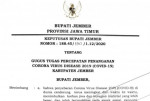
The Jember Covid-19 Response Acceleration Task Force was officiated based on a decree from Jember district head No.: 188.45/180/1.12/2020 on March 31. The regulation itself was a revision that includes the Task Force’s membership composition and their job description.
In the decree, the head of Communication and Information Office, Head of Protocol and Communication department at the Regional Secretariat, and the Health Office were appointed as a public liaison responsible for providing general information, agenda-setting, communication strategies, media monitoring, and spokesperson.
However, in reality, the decree had not functioned optimally since it was issued. COVID-19 Response Acceleration Task Force spokesperson Gatot Triyono, who also headed Jember Communication and Information Office, only announced the contact history of the three first COVID-19 patients on April 13.
Additionally, the COVID-19 Task Force has only held a handful of press conferences regarding COVID-19 responses, including the latest data on the cases. The Task Force had never held specific announcements on the growing number of confirmed positive patients or described where they had contracted the disease.
On July 24, there was a surge of new confirmed COVID-19 cases: 48 people in one day—the highest since the disease made its way to the region.
The Task Force spokesperson only reported the case via an infographic and the village/subdistrict origin of the patient via a message sent to a journalists’ WhatsApp Group on Saturday (25/7) early morning without explaining the surge of new cases or patients’ travel history.
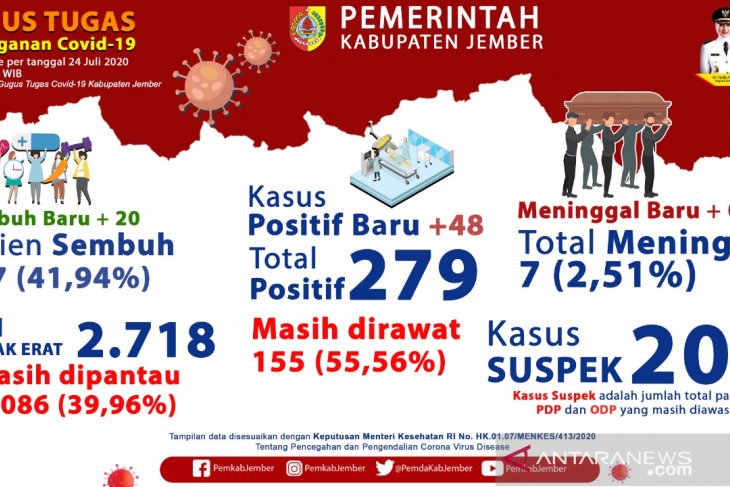
The infographic submitted by Jember’s Covid-19 Task Force Spokesperson regarding the 48 new positive cases via Jember district journalists’ WhatsApp Group on July 25. (ANTARA/ HO- Jember Communication and Information Office)
This is different from the Central Task Force and East Java Task Force, who always provided daily development regarding COVID-19 responses to the media in detail. Several Task Force in other districts and cities also held press conferences whenever there are any developments or trends of note.
Jember district head Faida however, claimed that all transparency and disclosure of information related to COVID-19 response had been published through the official Jember government website and social media accounts. (http://www.jemberkab.go.id, https://www.facebook.com/jemberkab/, https://twitter.com/PemdaKabJember, https://www.instagram.com/pemkabjember/, and https://www.youtube.com/user/Jemberkab.
“We have also published case data and COVID-19 responses by displaying [them] at the Task Force Command Post at Pendapa Wahyawibawagraha Jember building, 2nd Floor. Anyone can access them," she said.
Besides, she continued, Jember administration also published information related to COVID-19 through the COVID-19 data dashboard https://sites.google.com/jemberkab.go.id/dashboardcovidjember. However, the link was never properly announced to journalists and the public, so that most people were still unaware of its existence.
Faida also said that her government did not build a dedicated COVID-website because the latest information on Coronavirus was already available on the official government website—including its expense report, all accessible by the public.
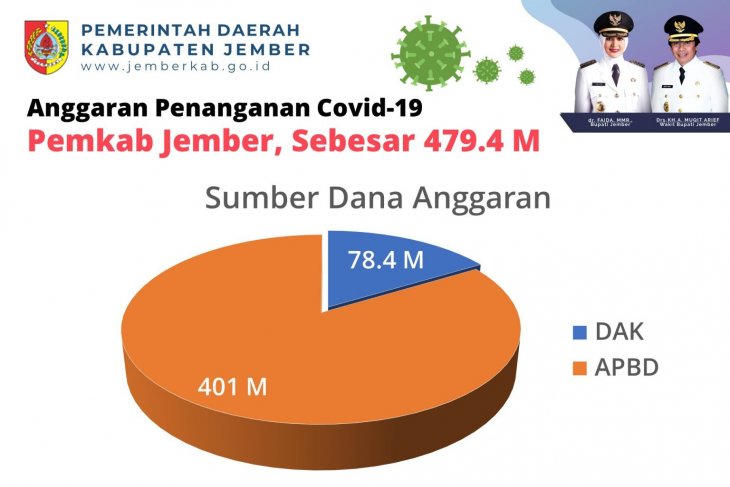
Data on COVID-19 funding in Jember as published on the Jember government’s official website (ANTARA/ HO- Jember Communication and Information Office)
COVID-19 response budget in Jember was also quite fantastic, reaching Rp479 billion. Nationally, Jember’s Covid-19 budget was the second largest after Makassar—the capital of South Sulawesi, compared to other districts and cities. Even though its 2020 Regional Budget (APBD) has not yet been ratified, Jember administration is currently using a Budget based on a district head decree limited to routine and urgent matters.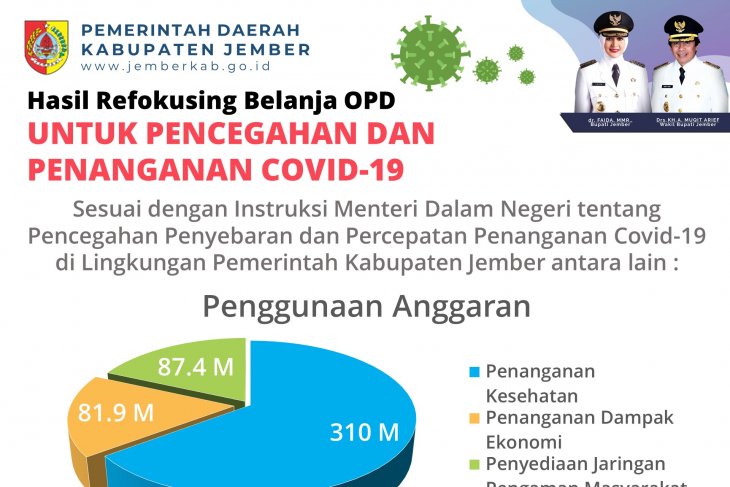
Data on the allocation of COVID-19 budget expenditure in Jember, which is displayed on the official website of Jember administration (ANTARA/ HO- Jember Communication and Information Office)
Responding to this, Faida explained that the source of funding for the COVID-19 response came from Jember’s Regional Budget for the year 2020 of Rp401 billion and the Special Allocation Fund (DAK) of Rp78.4 billion, bringing the total to more than Rp479 billion.
The Rp 401 billion consisted of Unexpected Expenditure (BTT) of Rp 1 billion and the reallocation of Regional Apparatus Organizations (OPD) spending (the “refocusing” budget) of Rp 400 billion.
Meanwhile, the Tobacco Excise and Production Profit Sharing Fund (DBHCTHT) of Rp 45.5 billion and hospital medical equipment of Rp32.9 billion made up the Rp78.4 billion of the DAK fund.
From the Rp479 billion budget, Rp310 billion was used for medical response, Rp81.9 billion on economic stimulus, and Rp87.4 billion for public safety net provision.
Agreeing with Faida’s clarification, Jember’s COVID-19 Task Force spokesman Triyono also said that all the latest information on COVID-19 had been submitted to the regional administration’s official website and social media accounts, and in collaboration with several local media in Jember.
"Every day, we released the progress of the Task Force’s activities. Both in COVID-19 case responses and the assistance we provide the people,” Triyono said.
The Communication and Information Office also built a COVID-19 dashboard that can be accessed by the public. Hence, regarding public information disclosure, Triyono believed that the Task Force had done their job.
He also said that the flow information on COVID-19 was one-way, from the Head of the Task Force (Jember District Head) or Task Force Spokesperson (Head of Communication and Information Office). Therefore, every piece of information can be controlled.
The spokesperson, Triyono continued, will do their best in responding to journalists’ questions regarding COVID-19. However, he would still have to collect some data first and cannot provide a quick answer for technical matters.
However, the fact was all questions were being directed to the spokesperson. In the meantime, the appointed party had not always been ready with answers because there was no coordination with other OPD. The spokesperson had not been equipped with anything to answer questions from journalists.
Triyono further admitted that not all journalists or the public aware of the COVID-19 data dashboard (https://sites.google.com/jemberkab.go.id/dashboardcovidjember). The dashboard was meant as a monitoring tool on the latest information on Coronavirus. However, the address or the link itself was never officially announced on the regional government’s official website and social media accounts.
He also said that the complete data on the latest COVID-19 development can be accessed by any members of the public, including journalists if they visit the Task Force Command Post in Pendapa Wahyawibawagraha Jember. The link to the COVID-19 dashboard was displayed there too.
"If there is an assumption that the Task Force is trying to hide information, it is not true because we have the COVID-19 dashboard that serves all the data on [Covid-19] responses that can be accessed by the public. But we need time," Triyono said.
The information published in Jember’s COVID-19 data dashboard consisted of six categories: COVID-19 data and its transmission; social assistance radar (an integrated socio-welfare data for social aids); health protocols (Task Force’s activities in implementing Covid-19 health protocols); “tough pesantren” (Task Force’s programs in pesantren or Islamic boarding schools); the link to jemberkab.go.id website that contained news from the Jember government, tough market (COVID-19 responses in markets), social aid data (social safety net data); and “new normal” (informational video on health protocol in public facilities, hotels, and restaurants).
However, compared to the websites of other task forces—such as the central government’s and East Java’s (infocovid19.jatimprov.go.id), Jember’s data dashboard was not as complete. Regarding this matter, Triyono promised to catch up with other Task Forces to provide the public with more detailed information.
What the dashboard lacked including a detailed budget for the social safety net and social assistance, spending report for the COVID-19 fund, and a complete list of aids from external parties that had been distributed by the Task Force.
Triyono was also reluctant to answer how much budget was allocated for the Communication and Information Office towards the publications/campaigns on COVID-19.
He said that his Office would improve their COVID-19 data dashboard because all information related to the coronavirus had to be presented according to the instructions from the District head.
The following is a table of confirmed positive patients in Jember, starting from March with one case, then increased to 11 cases in April, May (41 cases), June (113 cases), and finally tripled by the end of July at 368 cases.
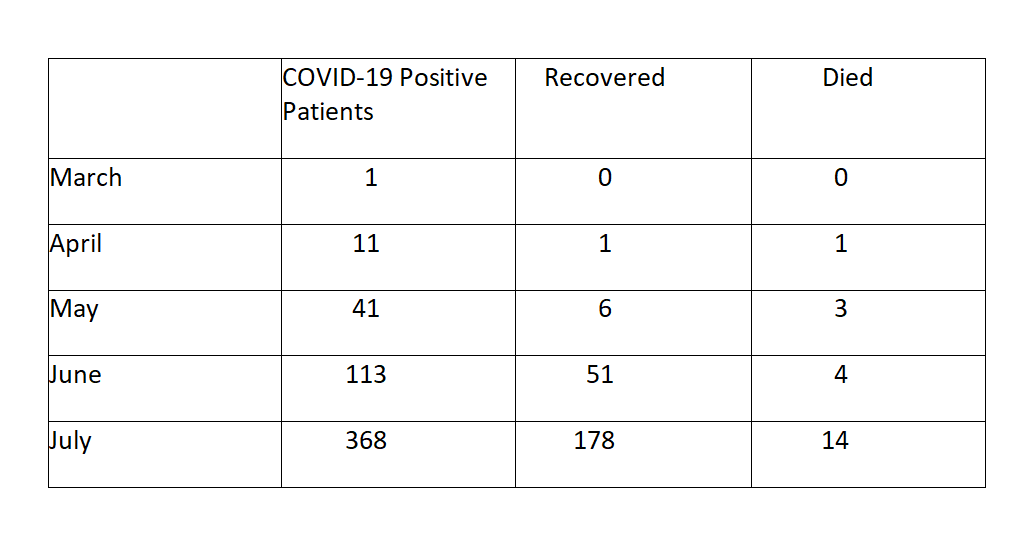
Based on the Task Force’s data on July 31, there were 368 confirmed COVID-19 cases, of which 178 (48.37 percent) had recovered, and 176 (47.83 percent) were being treated, while the death toll had raised to 14 people.
There were 105 suspected cases in Jember, a total of 2,847 close contacts, and 950 patients were under observation (33.37 percent).
There were six COVID-19 referral hospitals in the district appointed by East Java Governor Khofifah Indar Parawansa: dr. Soebandi state hospital, Baladhika Husada military hospital, Jember Lungs state hospital, Jember Klinik Hospital, Bina Sehat hospital, and Citra Husada hospital. Meanwhile, other hospitals proposed for COVID-19 treatment were Balung state hospital, Kalisat state hospital, Kaliwates state hospital, and Siloam Hospital.
The spokesperson for dr. Soebandi state hospital drg. Septiono Heriawan said that the hospital was equipped with health facilities for treating COVID-19 patients. Heriawan mentioned 81 isolation beds, with six negative-pressure isolation beds and 75 natural airflow isolation beds; 2 units of ventilators; one COVID-19 isolation room in the ER; and one operation room dedicated for COVID-19 patients.
The hospital also received a PCR examination kit from the National Disaster Mitigation Agency (BNPB) that was able to analyze as many as 150-200 specimens per day to complement the hospital’s Rapid Molecular Test (TCM) that could run through 48 samples per day.
There were also two lung specialists, three internal medicine specialists, three clinical pathology specialists, and three radiology specialists to help treat COVID-19 patients.
Lack of Transparency Over COVID-19 Budget
In preparing its COVID-19 budget, it was revealed that the Jember administration did not involve or coordinate with the Legislative Council (DPRD Jember). The Council also claimed that it never received any copy of the Rp479 billion budget allocation plan.
DPRD Jember deputy chairman Ahmad Halim said that the legislative body was never involved from the planning stage, distribution, to execution. Therefore, it had been difficult for the Council to monitor the use of the sizeable budget.
"The nominal Rp479 billion was a unilateral decision by the district head. We never saw any documents on [Covid-19 budgeting]. Most of all, on technical matters, we are totally in the dark," said Halim.
The Great Indonesia Movement (Gerindra) Party politician also said that the Council had summoned the Jember Covid-19 Task Force several times for an audience on the progress of the local COVID-19 situation. But they never showed up.
"In Jember, the reality is, [the Legislative Council] are not involved like in other regions. Only the executive knows the budget. So, it is difficult for us to monitor their budget spending. It is as if the information was covered up," Halim continued.
He assumed that there were elements of forethought on the part of the executive to cover up the budget. Halim also considered that the budget transparency on COVID-19 response in Jember as very bad. He had more reason to worry as the region also received potentially-overlapping assistance from the budget allocation from the central government, the East Java provincial administration, Jember’s Regional Budget (APBD), and village funds.
"So far, information disclosure and COVID-19 budget transparency are not available to the Council, let alone to the general public. We can only monitor the progress through social media and media coverage," Halim continued.
Jember University’s public policy expert Hermanto Rohman said that in responding to COVID-19, referring to the circular from the Public Information Commission (KIP) No. 2 of 2020 issued in April, there were seven categories of information that need to be publicly announced.
1. Information regarding types of disease, transmission, source of infection (epicenter/cluster), and prevention efforts.
2. Information on COVID-19 transmission while protecting the personal data of ODP (a person under monitoring), PDP (patient under surveillance), confirmed positive patients, and those who had been declared recovered by the authorities.
3. Information on COVID-19 transmission that served as an early warning for the public, including information on transmission at the hamlet level, village, or subdistrict while protecting personal data; and efforts to mitigate transmission risk by local governments.
4. Information on health services including referral hospitals/health facilities, hospital capacity to treat COVID-19 patients; budget plan, distribution and availability of personal protective equipment (PPE) in health service units; access to rapid test facilities; health service hotline number; mechanism/protocol for people with health concerns; and complaint mechanism regarding COVID-19 response and services.
5. Information on postmortem handling and dedicated burial locations for COVID-19 patients.
6. Information on access, costs, and health care coverage for the people for testing and treatment of COVID-19.
7. Information on policy plans in COVID-19 responses and its revisions.
"Of the seven information parameters, I think Jember [administration] is still limited to [providing] quantitative, numeral information and the transmission at villages and subdistricts, but not yet at the level of hamlets," said Rohman.
While the information on health services, spending, and distribution, including availability and complaint mechanisms, had not been fully implemented. Let alone information on public ability to access health services.
According to Rohman, the role of the media was used more as capitalization for Jember government and district head’s program information, rather than a form of transparency and accountability, as well as providing accurate data and information that the public needed.
"This is exacerbated by poor public communication. When a piece of information is not being communicated completely or optimally and must go through a lengthy bureaucracy with a strict chain-of-command. Waiting for instruction and permission from the district head as chair of Jember’s COVID-19 Task Force," said Rohman, who taught the State Administration program at the Faculty of Social and Political Science at the University.
He also believed that information disclosure on Covid-19 was necessary and mandatory, primarily referring to Article 4 and 10 of Law No. 14 of 2008 that obliges public institutions to provide and distribute accurate, factual, and truthful information.
This includes information on policy, program, and budget. According to the law, the three information were parameters that must be disclosed to the public. But, Rohman was quite concerned about the condition in Jember.
If the information on the Covid-19 program policy and response was unclear, he continued, it would affect the effectiveness of the response itself. Because they were related to how the regional government managed the pandemic, and an ineffective response could lead to more losses of human lives.
According to Rohman, the level of effectiveness would be hard to monitor because there was little information disclosure. The fact it was intentional on the part of the Jember administration—since the pandemic coincided with the regional election, made it prone to capitalization and abuse, especially in budgets and programs.
"With the large fund, if there is an actual and effective response program, Jember would become a green zone area. [But it’s not], which means undisclosed information is prone to mismanagement of polices, even budget," said Rohman.
Meanwhile, Chair of East Java Information Commission Imadoeddin said that his Commission always conducts yearly monitoring and evaluation to measure public bodies’ obedience towards the Law on Public Information Disclosure. The assessment was presented through an award on Public Information Disclosure and Information Management and Documentation Officer (PPID).
"However, in 2019, we could not assess the Jember region, whether it was already informative, towards being informative, informative enough, less informative, or not informative. Because they did not return the Self-Assessment Questionnaire (SAQ) to East Java [Information Commission]," said Imadoeddin.
He said that the Commission had sent questionnaires to 38 districts and cities in East Java province to be filled and then verified by an assessment team, followed by a visit to the public agencies. However, two districts had not returned the questionnaire: Jember and Madiun.
According to Imadoeddin, there were several reasons why a region declined to participate in the Commission’s Public Information Disclosure Award. Some did not want to be assessed for transparency of information, they might not have the infrastructure or human resources to manage it, and it could also be the local government’s policy.
In 2018, Jember was ranked 27th out of the 38 districts and cities in East Java in public information disclosure based on the assessment by East Java Information Commission.
"Jember [fell into the] not informative [category]. Therefore, we continue to encourage all of its public bodies to be more informative in implementing the Law on Public Information Disclosure," Imadoeddin continued.
Regarding information disclosure during the COVID-19 pandemic, the Central Information Commission (KIP) issued a circular No. 2 of 2020 on Public Information Services during Public Health Emergency due to COVID-19 on April 6.
In the circular, KIP obliged public bodies to provide, distribute, and or issue public information that is accurate, factual, and truthful, under their authority to the public, in addition to information that is exempted under the provisions.
The Central Information Commission also requested the chairpersons of Covid-19 Task Forces and regional heads to provide the public with real-time data/information systems on Covid-19 and optimize online-based information services during the pandemic.
“The East Java Commission also issued a circular No. 1 of 2020 on Public Information Disclosure in COVID-19 Social Assistance Programs in East Java, which consisted of ten items,” said Imadoeddin.
One of them was that the regional government is obliged to inform the public transparently on social aid programs, including the type and form of the program, source and amount of the budget, goal and target recipients, the requirements and criteria of beneficiaries, as well as program objectives.
Local governments are also required to produce reports on program realization and budget and inform the public through information boards and other means accessible to the public.
“We hope that local governments or public agencies can open the widest possible access to information to the public during the pandemic so that no information is being covered up, both COVID-19 data and budget,” Imadoeddin added.
Article 52 of the Public Information Disclosure Law stipulated that public bodies that intentionally do not provide, do not distribute, and or do not publish Public Information in the form of regular public information, public information that must be announced immediately, public information that must be available at any time, and or public information that must be provided based on request per this law, and resulting in damages for other parties, is subject to a maximum imprisonment of one year and or a maximum fine of Rp5,000,000.00 (five million Rupiahs) (US$335).
However, before a public body could be imposed with a criminal sanction, the public would need to submit an information dispute to the Information Commission. After going through several stages, a criminal case report can then be filed to the Police.
Information disclosure in COVID-19 response is direly needed because it is one of the ways to educate the public regarding the pandemic, as well as to increase the public’s awareness in implementing the health protocols.
Reporter: Zumrotun Solichah
Editor: Didik Kusbiantoro
COPYRIGHT © ANTARA 2020